What Are Genes and Alleles?
Genes are segments of DNA that carry instructions. Alleles are the different versions of a gene that exist in a population. Understanding the difference is key to reading any genetic report.
The words "gene" and "allele" appear constantly in genetics, but they are not interchangeable. Understanding the difference helps you make sense of genetic test results.
What Is a Gene?
A gene is a specific segment of DNA that carries instructions for making a functional product — usually a protein, sometimes a functional RNA molecule. Genes are located at fixed positions on chromosomes. The human genome contains roughly 20,000 to 25,000 protein-coding genes.
Each gene has a name and a symbol. For example, the gene BRCA1 encodes a protein that helps repair damaged DNA. The gene CYP2D6 encodes an enzyme involved in metabolizing many medications.
What Is an Allele?
An allele is one version of a gene. Because you have two copies of most chromosomes — one from each biological parent — you also have two copies of most genes, one on each chromosome. Each copy is an allele.
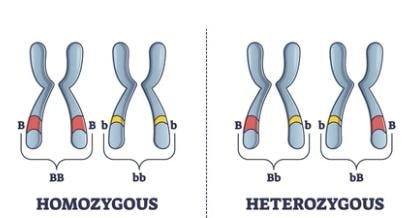
Alleles can be identical or different. If both alleles are the same version, you are homozygous for that gene. If the two alleles differ, you are heterozygous.
Variation in alleles is normal. Most alleles differ from the reference sequence without causing any health problem. Some alleles are associated with increased or decreased risk of certain conditions. Others affect how the body processes medications.
Variants, Mutations, and Polymorphisms
The word variant describes any difference from a reference DNA sequence. "Mutation" and "polymorphism" are older terms that are still used but can be misleading.
Genetic reports often classify variants:
- Pathogenic: strong evidence the variant causes or significantly increases risk of a condition
- Likely pathogenic: evidence suggests the variant is harmful, but less certainty
- Variant of uncertain significance (VUS): not enough evidence to classify as harmful or benign
- Likely benign / Benign: evidence suggests the variant does not cause the condition in question
Classification can change as more evidence accumulates.
Why This Matters for Genetic Testing
When a genetic report identifies a variant in a gene, it is describing a specific allele — a version of that gene that differs from the reference. The clinical significance depends on which gene is involved, what the variant does to the protein, and what the scientific literature says about that specific change.
At Genetic Insights, we help patients understand exactly what a variant classification means — and what it does not mean — in the context of their personal and family history.
Key Takeaway: A gene is a segment of DNA with a specific function; an allele is one version of that gene. Variant classification — pathogenic, VUS, benign — determines whether a difference in an allele is clinically meaningful.
Source: NHGRI Genetics Glossary
Explore Topics
Written by
Dr. Michael P. Vaughn
Content creator and writer sharing insights and stories.