How Many Chromosomes Do Humans Have?
Most human cells contain 46 chromosomes arranged in 23 pairs. Learn what chromosomes are, how they carry your genes, and what happens when the number is off.
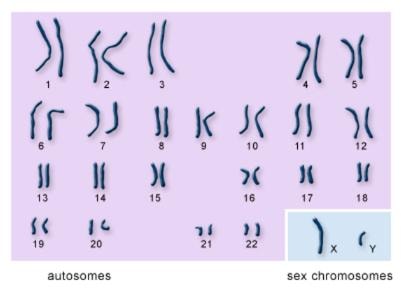
Most human cells contain 46 chromosomes, organized into 23 pairs. One chromosome in each pair came from your biological mother and one from your biological father.
What Is a Chromosome?
A chromosome is a tightly packaged structure made of DNA and proteins called histones. The DNA is wound around the histones, then coiled further, allowing an enormous amount of genetic material to fit inside a cell nucleus.
Each chromosome carries many genes. Genes are specific segments of DNA that contain instructions for making proteins or functional RNA molecules. The human genome contains roughly 20,000 to 25,000 protein-coding genes distributed across the 23 pairs of chromosomes.
The 23 Pairs
The first 22 pairs are called autosomes. They are numbered roughly by size, with chromosome 1 being the largest.
The 23rd pair consists of the sex chromosomes. People with two X chromosomes are typically female; people with one X and one Y chromosome are typically male. The Y chromosome carries genes involved in male sex determination and fertility, while the X chromosome carries many genes unrelated to sex.
What Happens When the Number Is Wrong?
Errors during cell division can result in a cell receiving an extra or missing chromosome. This is called aneuploidy.
Some aneuploidies are incompatible with survival. Others result in recognizable conditions:
- Trisomy 21 (Down syndrome): three copies of chromosome 21
- Trisomy 18 (Edwards syndrome): three copies of chromosome 18
- Trisomy 13 (Patau syndrome): three copies of chromosome 13
- Turner syndrome (45,X): a single X chromosome
- Klinefelter syndrome (47,XXY): two X chromosomes and one Y
Chromosomal analysis — called a karyotype — can identify these and other structural changes in chromosomes.
Chromosomes and Genetic Testing
Whole genome sequencing examines the DNA sequence across all chromosomes, not just the number. It can detect single-letter changes, small insertions or deletions, and in some cases larger structural rearrangements that a standard karyotype might miss.
At Genetic Insights, we help patients understand what chromosomal and sequence-level findings mean for their health and their family.
Key Takeaway: Humans typically have 46 chromosomes in 23 pairs. Errors in chromosome number can cause recognizable conditions, while sequence-level changes require more detailed testing to detect.
Source: NHGRI Chromosomes Fact Sheet
Explore Topics
Written by
Dr. Michael P. Vaughn
Content creator and writer sharing insights and stories.