How Is DNA Copied, and Which Proteins Reduce Mistakes?
Before a cell divides, it must copy its entire DNA. Discover the remarkable proofreading machinery that keeps errors rare — and what happens when it breaks down.
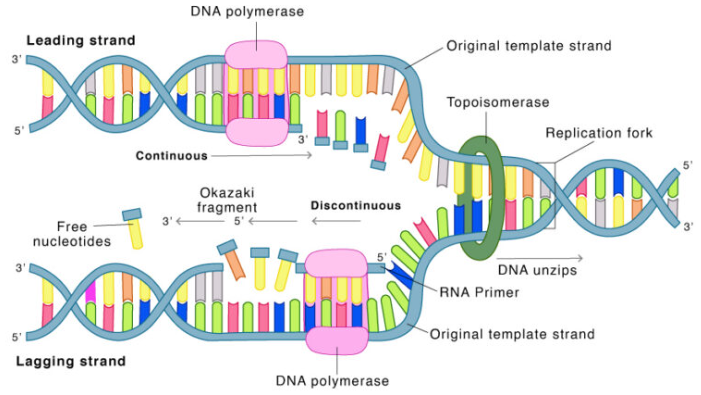
Before a cell divides, it copies its DNA so each new cell can receive a complete set. This process is remarkably accurate, but it relies on a team of specialized proteins working together.
The Copying Machinery
Proteins called helicases separate the two DNA strands. Each old strand then guides the construction of a new partner because A pairs with T and C pairs with G. DNA polymerases add the new letters. Primase makes short starting pieces, and ligase joins pieces of newly copied DNA together.
Built-In Proofreading
Copying is accurate, but errors can happen. Many DNA polymerases have a proofreading function: they can remove a recently added wrong letter and try again. After copying, the mismatch repair system checks for pairs that still do not fit. Proteins including MSH2 and MSH6 help recognize errors; MLH1 and PMS2 help coordinate their removal and replacement.
This is one reason cells can make enormous numbers of copies without accumulating an error at every step.
When Repair Fails: Lynch Syndrome
Not every DNA change comes from a copying mistake. DNA can also be damaged by normal cell chemistry or outside exposures. Different repair systems handle different problems.
If a mismatch repair gene stops working, copying errors can build up, especially in repeated stretches of DNA. Inherited changes affecting this system can cause Lynch syndrome, which raises the risk of several cancers including colorectal and endometrial cancer.
Genetic testing can identify inherited changes in mismatch repair genes, allowing for earlier screening and preventive care.
Key Takeaway: Polymerase proofreading and mismatch repair are two separate safeguards against copying errors. When these systems carry inherited variants, cancer risk can increase.
Sources: NHGRI DNA Replication; NCI Lynch Syndrome
Explore Topics
Written by
Dr. Michael P. Vaughn
Content creator and writer sharing insights and stories.